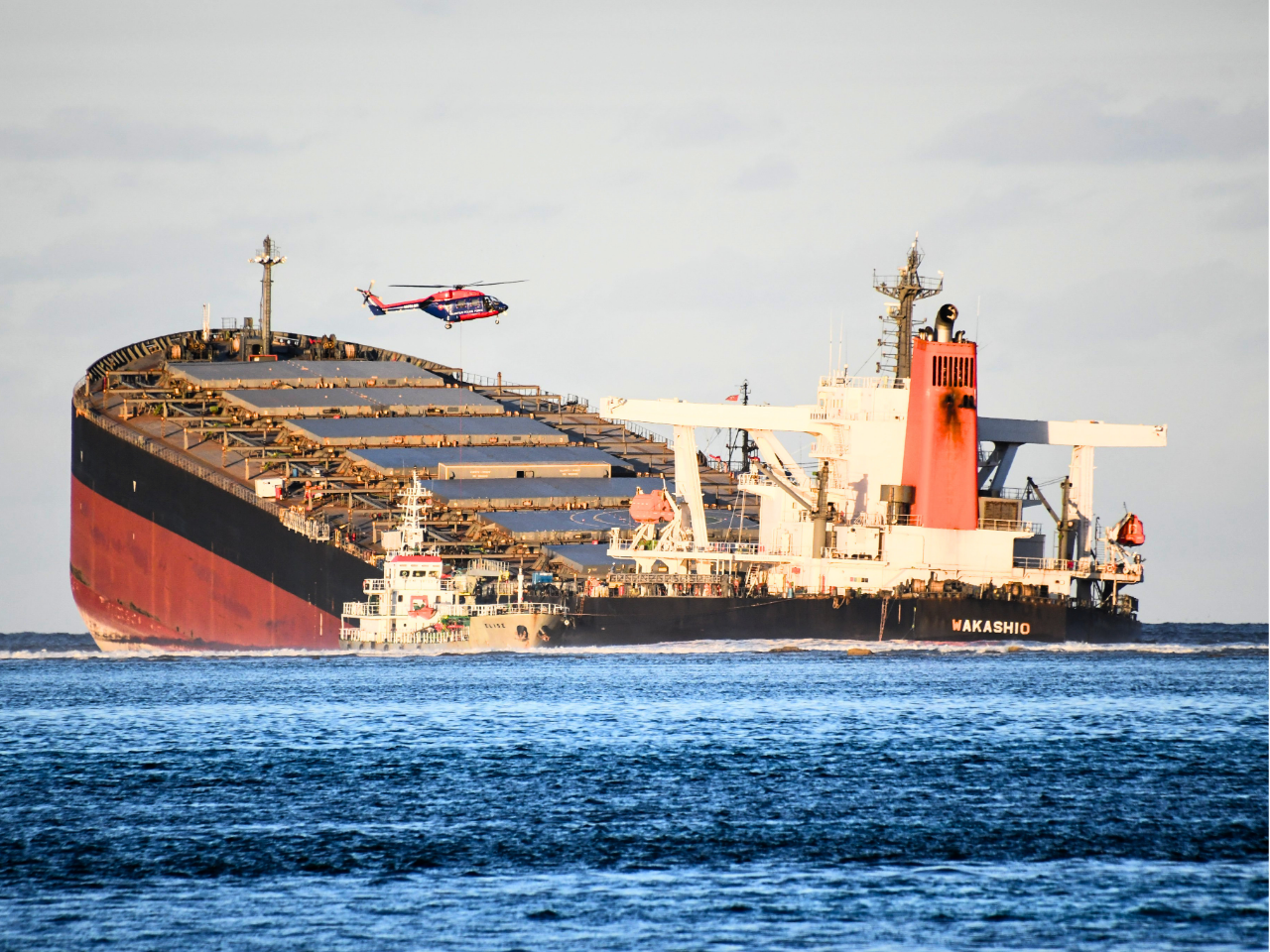
The cargo ship MV Wakashio, carrying 2,300 tonnes of liquefied chemical dioxins, hit the rocks off the eastern coast of Mauritius on 25th July 2020, destroying one of the country’s most colorful coral reef ecosystems. This huge ship sailed into the coral for more than a kilometer, killing marine life under a blanket of sediment. It began to leak some oil, spilling some 1,000 tonnes of heavy fuel into the surrounding waters, including the protected Blue Bay Marine Park, about a fortnight later. It was the largest environmental catastrophe in Mauritius’s history, and not only did it affect biodiversity but also the fisheries and tourism activities of the coastal communities, which depend on them for their livelihoods. Despite accounting for less than 1% of the ocean floor, coral reefs support over one quarter of ocean life and provide an estimated $2.7 trillion worth of ecosystem services per year. Small island developing states (SIDS) are dependent on survival in ecological and economical aspects. Recent changes in the Earth’s climate, increasing pollution on a global scale, and overfishing of desired species all pose a significant threat to reefs all over the world. Scientists predict that reefs may no longer exist by 2050 if the damage continues at the current rate.
Dr. Nadeem Nazurally, a marine scientist, couldn’t sit back and watch as the crisis in his country unfolded. With the support of the Global Environment Facility Small Grants Programme (GEF SGP) implemented by the United Nations Development Programme (UNDP), Nadeem spearheaded a coral rescue mission with his organization, ecoMode Society, in the community. The collection of coral fragments from the damaged reef and their transfer to the coral nursery at Pointe-Aux-Feuilles were done by local fishers/seaweed farmers, mainly women. Coral pieces are grown with a new technique known as microfragmentation. Once these colonies are established as genetically identical, they will be replanted to encourage the growth of naturally occurring coral.
Over 1,800 parent colonies were used to grow corals, with 8,400 successfully transplanted and reattached to the shipwreck site in 200 square meters of coral reef on the island’s southwest in two years. More than 50,000 people were reached through outreach efforts related to education. Momentum gathered, and by 2023, it had grown to 86,000 square meters, the size of twelve football pitches, and was designated a voluntary marine conservation area. By May 2026, local communities had returned over 25,500 corals, more than 3,400 of which were established from mother colonies. The local community has been deeply committed to the restoration project, with over 25,500 corals now restored, including over 3,400 from mother colonies.
Nadeem’s interest in restoration of the coral reef actually dates back much earlier. In 2013 he completed his first SGP project, through the NGO ELI Africa, which was the first community-based coral restoration project ever conducted in Trou-aux-Biches, Mauritius. The early experience had an influence on his science career and his overall philosophy of using hard science research with an honest involvement in the community. Through early support, Nadeem’s path is an inspiring indication of what can be achieved with just one well-targeted grant; it laid the groundwork for a career and an institution and eventually led to a national response to the environmental crisis. Since 1996, SGP has backed 197 projects in Mauritius, ensuring that community empowerment is not only a good thing to do but also one of the best ways to solve environmental crises on a grand scale.