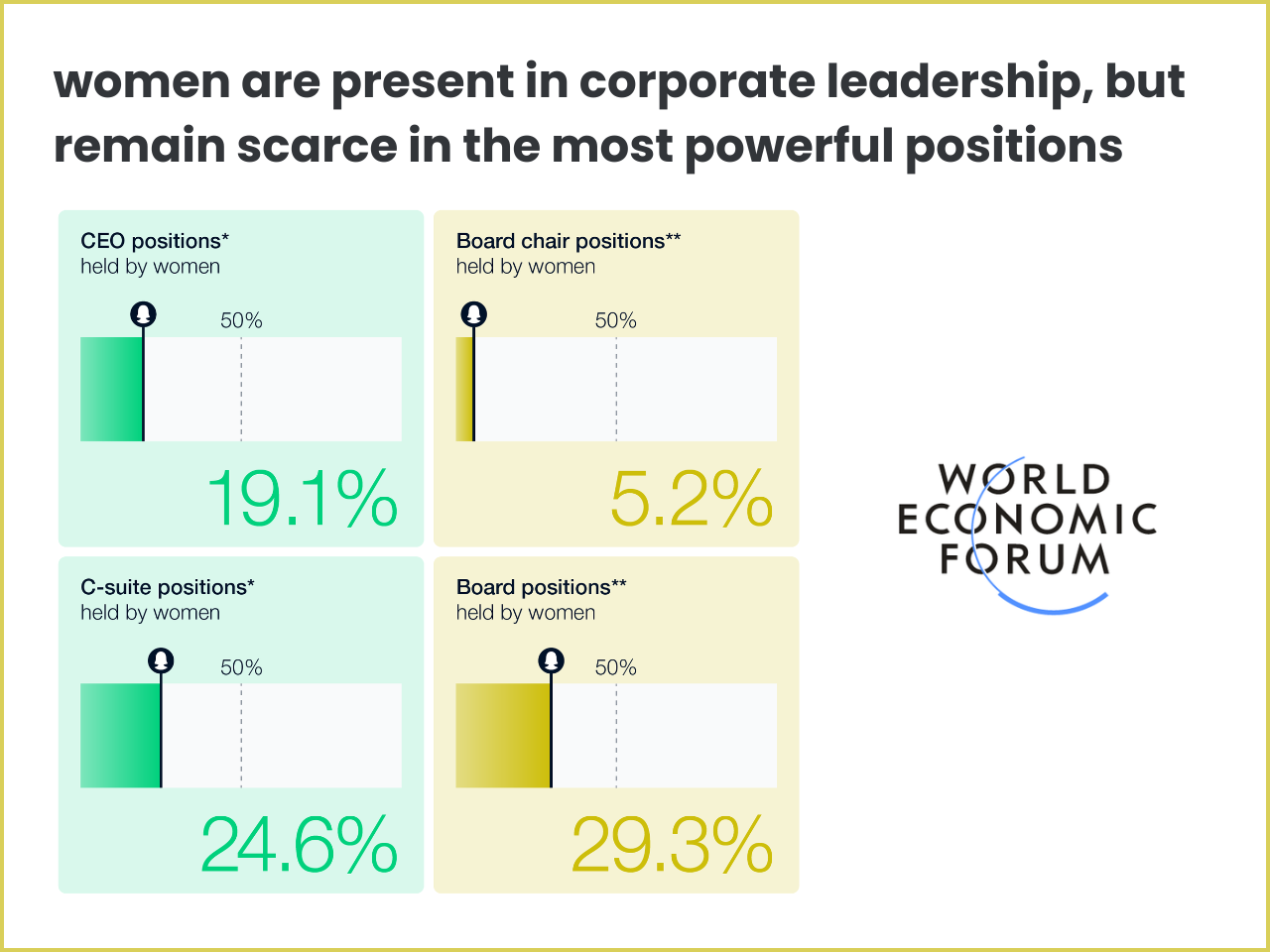
The June 2026 World Economic Forum Insight Report examines the current state and trends in women’s representation in corporate leadership and why progress has been stalling and is now under threat in recent years. It shows the effects of structural headwinds on dozens of economies, based on LinkedIn and Egon Zehnder data.
Progress has been made, but momentum is inertia:
The proportion of women in leadership roles at the top of the management chain rose from about 27% to almost 30% over the past 10 years, and the number of women on boards more than doubled, from 15% to 29%. It’s when over 95 percent of major corporate boards include at least one female. It’s when it would have been a dream not that long ago. But all that is changing. Women’s hiring to C-suite and board positions has stalled or even slightly decreased since 2022. Economic conditions, growing corporate DEI initiatives, and, of course, C-suite growth have all slowed down. But this results in a slowdown at a moment when the cost of achieving diversity of leadership is increasing.
Gap zones:
Only 19% of company Chief Executive Officers (CEOs) are women; about a third of companies have Chief Financial Officers (CFOs), Chief Operating Officers (COOs), and Chief Technology Officers (CTOs) who are women; and half the companies have Chief People Officers (CPOs) or Chief Human Resources Officers (CHROs) who are women. The primary driving force behind these results is the lack of properly qualified candidates.
Representation among the workforce is even at the entry level. The number of women falls at each level in the hierarchy of the career ladder, the report said, a pattern it calls “drop to the top.” This occurs at different locations in the pipeline, depending on industry. In the oil, gas, and mining industries, women are at a disadvantage from the start. Despite women dominating technology and finance, their representation in senior management is declining significantly. There are no one-size-fits-all answers to closing gaps; there are industry-specific and stage-specific strategies.
Women’s Structural Barriers:
A report describes five interrelated barriers that contribute to the persistence of the talent gaps, no matter how much talent is available. One, career pathways continue to be very limited. Over 75 percent of incoming CEOs have previous C-suite experience, and almost 45 percent were CEOs before. Within the pipeline, women are even less likely to be promoted to CEO than men. Second, the professional networks are very skewed against women. In the majority of cases, males tend to have approximately 25 – 52% more links than females, with the number of links differing according to the level of seniority and being highest for females with senior leaders. Sponsorship, which is a greater career catalyst than mentorship, is less prevalent, and women are promoted less often when they receive sponsorship. Thirdly, career breaks are expensive. 55% higher than men are women to take breaks in their careers, and on average they are taking an additional six months. Females are, on average, eleven times more likely than males to quit their careers to take a break for parenthood at some time in their career. Career breaks are failures of career systems that are linear in nature. Fourthly, there are subjective and biased evaluation systems still in place. Two out of 5 people worldwide think men are better business leaders, and studies always indicate that the same profiles are rated better when associated with men.
Framework for sustainable change: four pillars
The report proposes that these solutions are viable. Reflect on the concept of leadership going beyond the linear career path. Reimagine power paths, build in a formal sponsorship system, and expand access to feeder roles. LVMH, Shiseido and McKinsey prove that to make work fair for men and women, structural measures are necessary and they must be taken internally.